
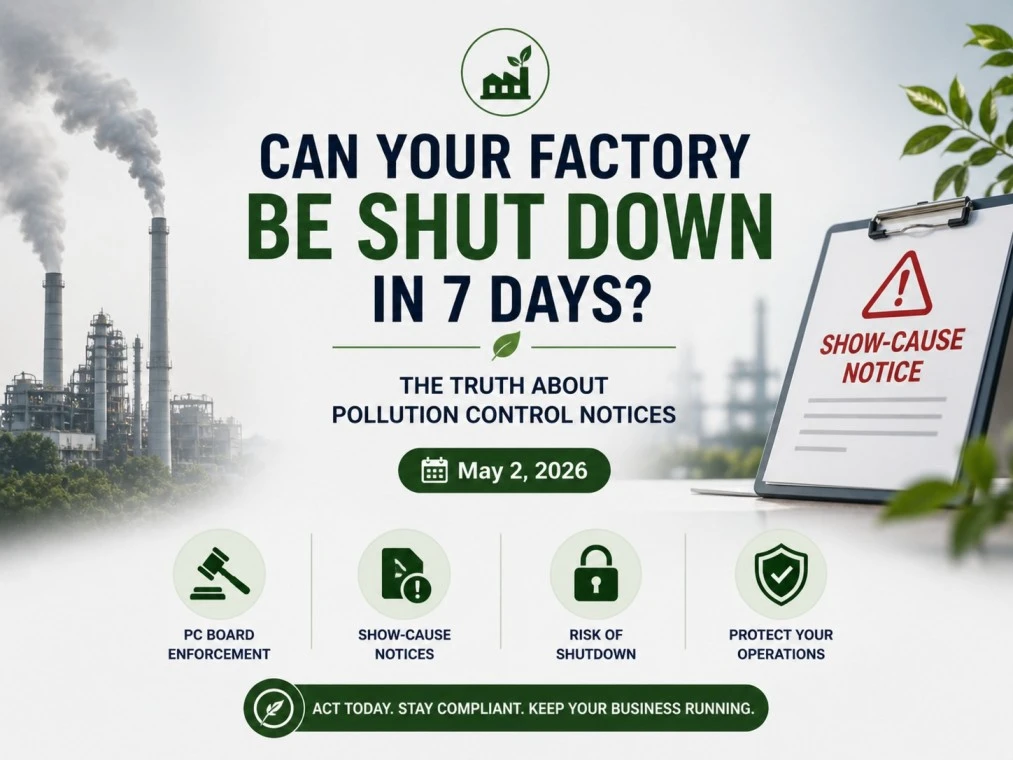
Can Your Factory Be Shut Down in 7 Days? The Truth About Pollution Control Notices
Imagine receiving a notice from the Pollution Control Board giving you just 7 days to respond — or face an immediate closure order. Can a factory really be shut down that quickly?
What Is a Pollution Control Notice?
A pollution control notice is a formal legal warning issued by authorities such as the State Pollution Control Boards (SPCBs) or the Central Pollution Control Board (CPCB). These notices are issued under strict environmental laws, including:
- Water (Prevention and Control of Pollution) Act
- Air (Prevention and Control of Pollution) Act
- Environment Protection Act
Can Closure Really Happen in 7 Days?
Yes — especially if your facility is found to be operating without a valid Consent to Operate (CTO) or if untreated waste is being discharged into the environment. Ignoring a Show Cause Notice often leads to an ex parte closure decision, where utilities like electricity and water are disconnected by local authorities.
Common Reasons for Notices
Many shutdowns happen due to weak compliance management rather than intentional violations. Common triggers include:
- Expired or missing Consent to Establish (CTE) / CTO
- Non-functional or poorly maintained ETP/STP systems
- Emission limit violations and improper hazardous waste storage
- Failure to maintain mandatory environmental documentation
What Should You Do Immediately?
If you receive a notice, do not panic, but do not delay. You must identify the exact technical violation and engage an environmental compliance expert immediately. Submitting a structured, documented response and fixing technical gaps within the window is the only way to prevent a production halt.
Protect Your Factory Operations
Environmental enforcement is stricter than ever. Don't wait for a notice—build a compliance system that prevents them.
Get A Compliance Audit